A workflow that becomes a node.
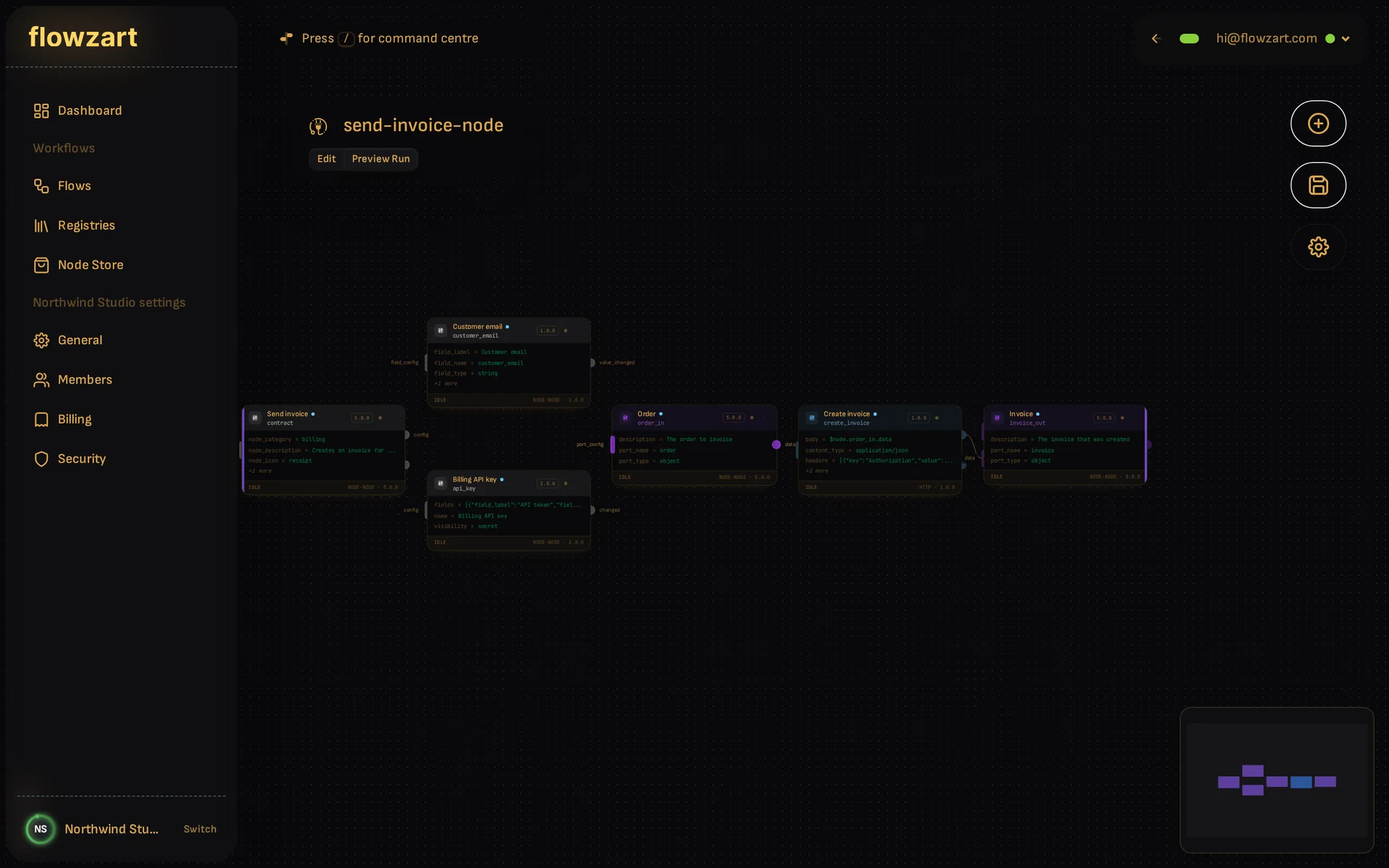
Declare a Contract inside any flow and it turns into a node you can place anywhere. Its fields, its secrets and its buttons are small nodes inside it. Open it, and the whole flow is there.
- 01 Node ContractSend invoice Declares the node: its name, its category, its icon.
- 02 Node InputOrder An input port. Data arrives here.
- 03 Node OutputInvoice An output port. Data leaves here.
- 04 Node Supply PortTools A callback port. During a run the node asks for something, and the handler wired to the port answers.
- 05 Node FieldCustomer email A setting on the node's card.
- 06 Node FieldDue in days A setting on the node's card.
- 07 Node SecretBilling API key A setting that is stored encrypted and never shown again.
- 08 Node ButtonSet up A button on the node that runs part of the flow inside.
- 09 The requestCreate invoice The work itself. It stays inside, out of sight.
- 10 Into the node The panel is the inside of the node. It closes, and one node is left.
Change a name on any small node; it comes through at the end.
If you have used automation tools before, you know a node as something the vendor writes and you consume. Here a node is something you write, on the same canvas, with the same nodes, in the same afternoon. The library is not a wall between you and the product.
Nothing is opaque
Opening a composed node reveals its canvas exactly as if it were the top level. Every level is inspectable, every value visible.
Reuse without copy-paste
Place the node in as many flows as you like. Change the flow behind it and publish a new version; the flows that use it pick it up from the registry.
Integrations are flows too
An integration for a vendor is a flow of HTTP requests with a Contract in front. Build it once, export it, install it in any space.
Wizards for the hard setups
A Node Wizard walks a person through a multi-step setup, redirects and callbacks included, so a node can ask for consent and keys the proper way.
Eleven small nodes make a node.
Each thing a node shows the outside world is contributed by one of these, placed inside the flow behind it.
Ready when you are.
Join the waitlist for a Concert Ticket, or see how it works right now.